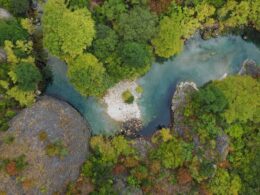





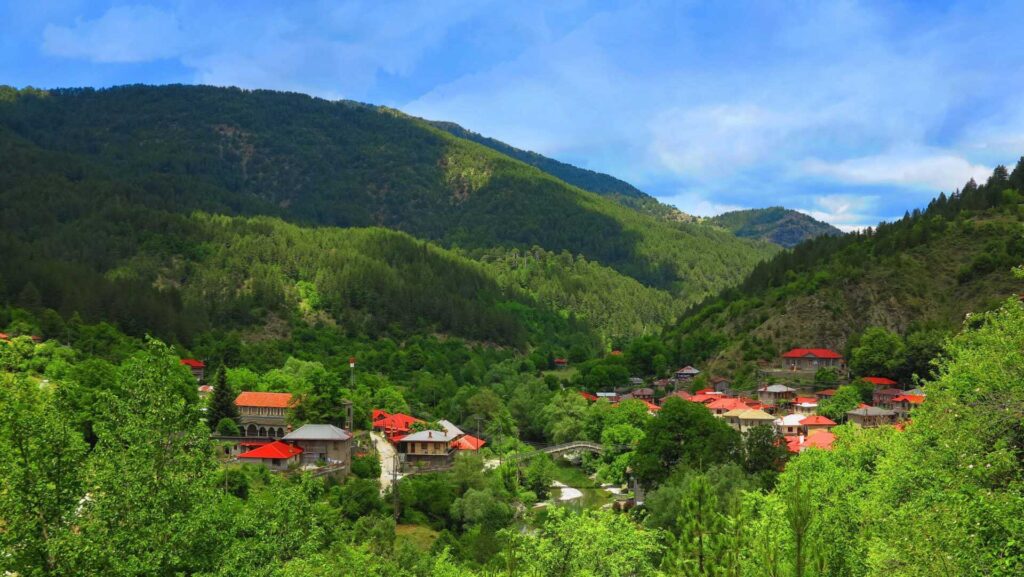
Vovousa is a distant but beautiful village in East Zagori. It is built at an altitude of 1000 m. in a mountain valley that is divided in two by the river Aoos that springs in the south. It belongs to the human-geographical and cultural unit of the Vlach villages of Pindos, is located 70 km northeast of the city of Ioannina and administratively belongs to the Municipality of Zagori.
Vovousa together with the villages Doliani, Vrysochori, Greveniti, Elatochori, Iliochori, Kavallari, Kastanona, Laista, Makrino, Tristeno and Flampourari make up the so-called Vlachozagoro.

This integration in the administrative unit of Zagorochoria shaped its historical course and influenced its economic organization and its relations with the Vlach villages of the surrounding areas, close and varied relations.
«The famous Valia Calda which many times served as a refuge for the infamous thieves extends above the village… There are green forests, from which the wood and the torch are extracted for Zagori and the other provinces of Epirus, where in summer men and women go there to carry home the torches they need, and their songs are very strange and their dances are inimitable…»
Ioannis Lampridis in “Zagoriaka” (p.83)


History and Information
The village is surrounded by large and dense forests of fir, beech and black pine. It is an area where the abundance of water makes it a great hydrological basin. The mountains that surround the area create a valley in which the main bed of the Aoos River is formed. At its lowest points, at an altitude of about 1000 meters, the river that now follows a northern course, passes through the settlement of Vovousa.

The settlement and its name
According to Fanis Dasoulas, PhD in Folklore at the University of Ioannina, all the idiomatic and linguistic forms of the historical name of the river are variations of a common root derived from the popular Latin phrase Amnis or Aqua or Fluvia Vivosa or Viosa. The use of the adjective vivosus, which literally means alive, presupposes the rapid and impetuous movement of the water or its cool texture
The settlement was first mentioned in 1592/93 in a manuscript of the Monastery of the Transfiguration of Meteora which is a valuable archive of toponyms and names from the period 1592/93 – 19th century. So the settlement pre-existed or had just been formed.
According to undocumented traditions, the village was formed by the union of small settlements, which have disappeared today, between the 16th and 17th centuries and since then it has been named after the river that crosses it. The original settlers were primarily engaged in agriculture and animal husbandry and secondarily in the exploitation of forest resources. In the course of time, it is very likely that the existing agricultural settlements of the mountain valleys coexisted with groups of mobile pastoralists who sought stable mountain homelands and who then integrated with the inhabitants of the settlement.
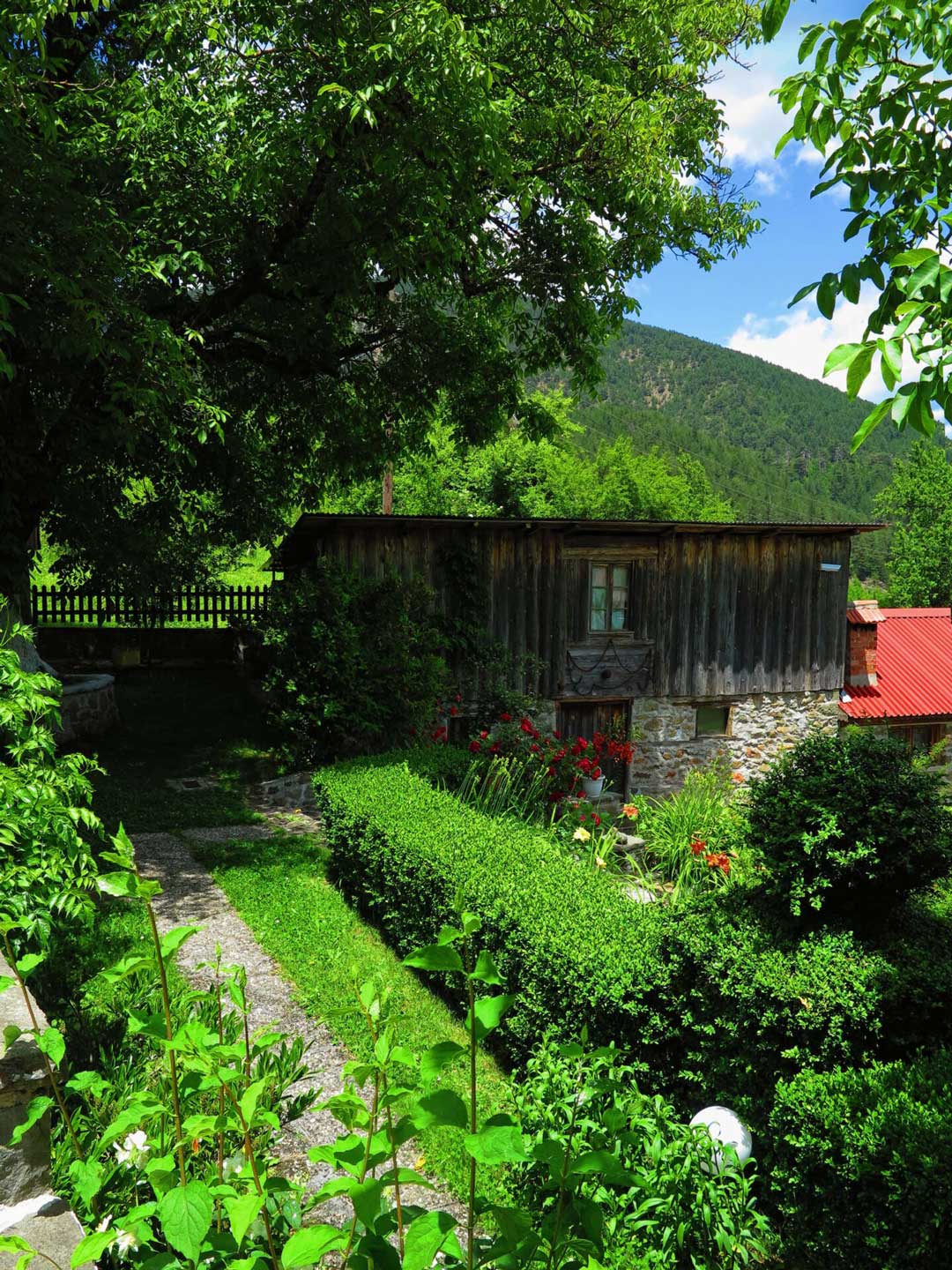
The French traveler F. Pouqueville, who passed through Vovousa in 1806, gives a brilliant picture of the village, describing the houses surrounded by gardens with many vegetables and many roses. It is an image that suggests a permanent installation, not a seasonal one.

Hydrokinesis
Vovousa, having the potential of water propulsion, was an important derveni (mountain pass) with a fully developed manufacturing function, just like other Pindos settlements. Merchants and producers of grain and woolen fabrics, processed and processed there, safely, the products that moved between different regions.
The technological starting point of these developments was the water saw, a real water-powered wood chopping machine, which achieved greater and higher quality production at a lower cost in time and effort and contributed to the rapid growth of logging production. The water saw has been known in Europe since the 14th century and its use became known in the Balkans in the late 16th century.
According to the residents of the village of Vovousa, the water saw was imported to Pindos from Bulgaria. The art was practiced by specific groups of craftsmen who roamed throughout the mountain range.
However, there was a continuous and massive use of the water saw in Greece only in Pindos. Technologically, this mechanism can be considered as the most complex tool ever built by the inhabitants of Pindos, in the pre-industrial era.
A large part of the inhabitants joined the gangs organized by the sawyers, i.e. the manufacturers-operators of the water saws. The participation of the residents of Vovousa was important. The endurance of the teams in the difficult geographical and climatic conditions of the mountains and the art of the sawmills was admirable.
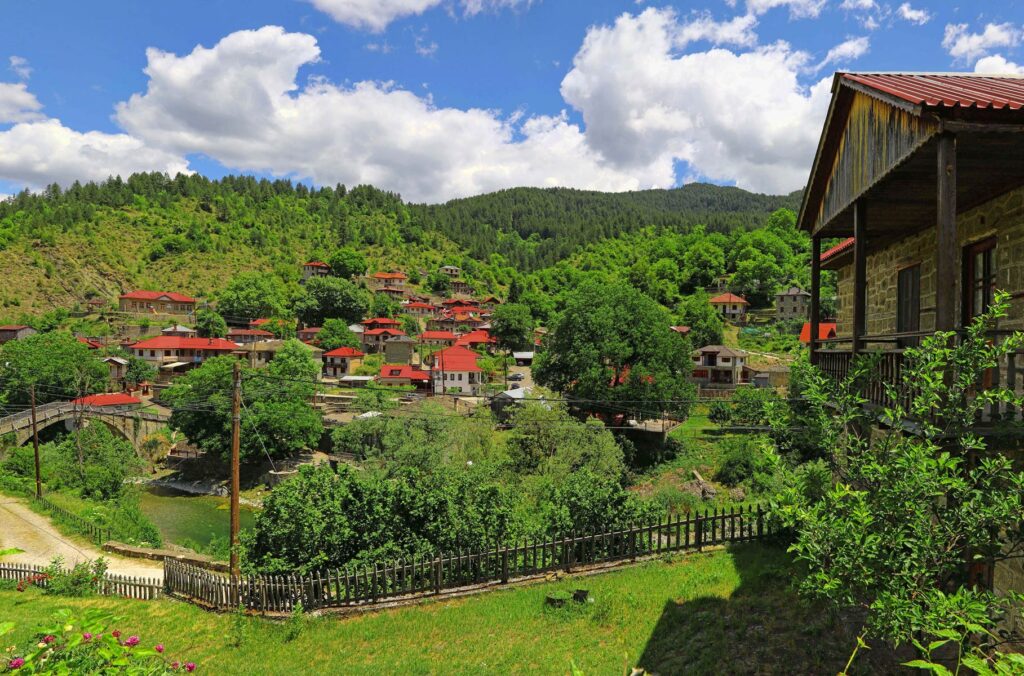
Vovousa during the Turkish Occupation
During the Turkish occupation, Vovousa, like the area of Zagori, came under the jurisdiction of Valide Sultan (the queen mother) and by paying taxes, like the rest of Zagorochoria, managed to maintain the privileged status under which the institution of self-government operated. It was the period of the great prosperity of the village and was considered one of the largest villages.
When in 1803 the youngest son of Ali Pasha, Salih, lent to the inhabitants a sum of money which, when they collected it, he refused to receive it asking for the amount in Venetian coins, as he had lent them. Refusal to accept another equivalent currency has cost residents around 4,000 grosses. This trick of Ali Pasha and his relatives was aimed at turning Vovousa (as well as those villages that could not repay the loan) into a feud (ciftlik). Anagnostis Hadjigeorgiou, one of Ali Pasha’s grammarians in Thessaly, who came from Vovousa helped in this difficult situation,and giving 20,000 “white” (silver coins), relieved the village of its debt. Unfortunately, Hadjigeorgiou lost not only his position but also his life.
Source: The information is translated from: Χρήστος Καραβίδης, ΤΡΑΓΟΥΔΙΑ ΚΑΙ ΧΟΡΟΙ ΤΗΣ ΒΟΒΟΥΣΑΣ, p. 19
Robberies and expatriations
The pressure of the Turks, the tyrannical domination of Ali Pasha and the robbery raids, forced the inhabitants to emigrate, both inside Greece and in the wider Balkan and Central European area. In 1817 about 120 families, belonging to the ruling class of Vovousa, left in groups in search of better fortune in eastern Macedonia and eastern Romulia where a group established a colony near Plovdiv, Bulgaria.
In 1833 they returned, setting up their households again and continuing the logging and supplying with wood not only Zagori but also many other parts of Epirus they reached again the prosperity they had before.
Between 1878 and 1883, robbery was rampant. Vovousa was at the center of this crisis, as a transportation center that was, but also as the more vulnerable village in Zagorochori in the presence of robbers from the villages of Grevena such as Perivoli, Distrato and Samarina.
The damage suffered by the villages of Zagori was incalculable and to such an extent that the inhabitants were forced, in that decade, to leave their place.Towards the end of the Ottoman Empire, with the abolition of privileges and due to the looting raids, the decline of both Vovousa and the general area began.
Source: The information is translated from: Χρήστος Καραβίδης, ΤΡΑΓΟΥΔΙΑ ΚΑΙ ΧΟΡΟΙ ΤΗΣ ΒΟΒΟΥΣΑΣ, p. 20, 22, 24
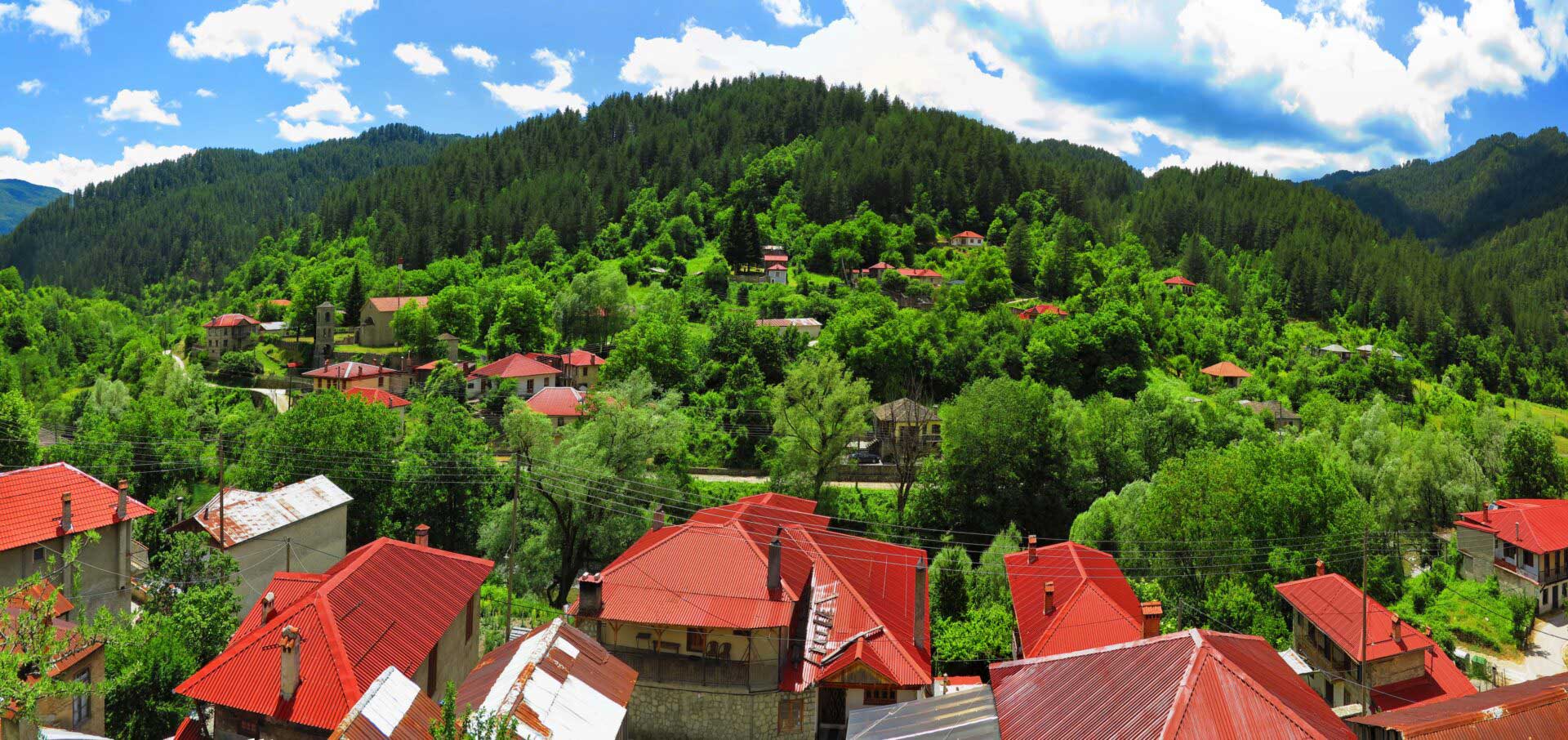
The liberation of Vovousa
In November 1912, in an engagement involving between a Turkish detachment and the inhabitants, ten houses and a large clock made exclusively of wood were burned. After the liberation, Vovousa with the Treaty of Bucharest in 1913 was annexed to the Greek state and underwent the changes of the mountainous volume of the Greek countryside. Unlike other neighboring villages, Vovousa did not show a strong population outflow because a large part of its economy turned to various craft activities, such as logging and transporting timber to Ioannina with sacks. There was a small influx of immigrants to Romania and later to the United States.
Source: The information is translated from: Χρήστος Καραβίδης, ΤΡΑΓΟΥΔΙΑ ΚΑΙ ΧΟΡΟΙ ΤΗΣ ΒΟΒΟΥΣΑΣ, p. 28
Romanian propaganda in Vovousa
The causes of the issue were Romanian grandeur and the need to disorient the Vlach-Moldavians due to loss of Transylvania from Austria-Hungary, and Bessarabia from Russia. Because any reaction to these Great Powers posed serious dangers to the hegemonies turned their attention to the Vlachs of Thessaly, Epirus and Macedonia whom they characterized of the same nationality. The creation of the Kutsovlach issue was first created in 1849. In 1863-64 it was officially supported by the Romanian government.
In the period from 1881 to 1886 and in the context of the Romanian propaganda, there was intense conversion pressure with the establishment of schools both in Vovousa and in the wider area. The effort did not have the expected success, and over time, the national sentiment of the residents was awakened and they reacted strongly.
In the period from 1917 to 1940 there was a new resurgence of Romanian propaganda. The Italians attempted to install consuls in the Wallachian villages, but met the reaction of the Greek Wallachians. In the fall of 1918, the “Principality of Pindos” was proclaimed by the Vlachs of Koritsa, who prevented the Greek army from taking Vovousa from the retreating Italians. This particular Republic lived for only one day, while 10 families of the propagandists were forced to relocate, for fear of reprisals, to the region of Northern Epirus.
Source: The information is translated from: Μιχαήλ Τρίτος, Το Κουτσοβλαχικό ζήτημα και Δημήτριος Χατζής, ΑΝΤΙΠΟΙΝΑ ΤΩΝ ΕΡΜΑΝΙΚΩΝ ΑΡΧΩΝ ΚΑΤΟΧΗΣ ΣΤΟ ΖΑΓΟΡΙ (ΙΩΑΝΝΙΝΩΝ) 1943-1944
The battle at Vovousa
At dawn on October 28, the Italian attack began outside Kalpaki of Ioannina, in Thesprotia and Pindos. The Italians repelling the light Greek divisions, arrived on November 3 in Vovousa, 20 km northwest of Metsovo, threatening to cut off the Ioannina-Kalampaka road.
That morning, Captain Anastasios Pappas arrived in the village first with all his soldiers left wandering for three days in Pindos, exhausted and with little ammunition and also cut off from the forces of Davakis who was defending on the line Smolikas-Kastaniani-Kiafa-Katafiki. Arriving in Vovousa, they found that the Italians and specifically the vanguard of the 3rd Alpine Division Julia were arriving in the village. Not having a radio, the captain immediately notified the military administration in Metsovo from the telephone line of the Gendarmerie Station. The lieutenant colonel who was in Metsovo, with whom Pappas spoke, was taken by surprise. He was not waiting for the Italians there, nor for Pappas, who normally had to be somewhere else. However, he was found at the right time in the right place.
The lieutenant colonel asked Captain Anastasios Pappas to keep a defense until reinforcements arrive. Thanks to the heroism of the captain who attacked suddenly with the few men of his company, and gave a victorious battle against the men of the Division Julia, the first retreat of the Italians was achieved. Pappas’s company played an important role at the beginning of the war. Despite the suffering of the soldiers and the lack of ammunition, he kept the Italians in Vovousa. And what is worth mentioning is that the Italian division consisted of warlike men with capable command. On November 9, 1940, the commander of “Julia”, General Mario Girotti, ordered the retreat of the division. A few days later, Greek forces recaptured the border crossings of Pindos.
Source: The information is translated from: Η μάχη στη Βοβούσα, Η Μηχανή του Χρόνου
“In the military history of Italy, the Greek-Italian war is one of its darkest pages. It was a useless, shameful war with negative consequences”
As the Italian journalist and writer Mario Cervi wrote in his essay “History of the Greek War” (Storia della guerra di Grecia)

The Germans in Vovousa
On October 19, 1943, German troops invaded Vovousa. They were accompanied by Italians, who did not accept the capitulation of Italy, coming from villages of Konitsa. Due to the fact that the Hellenic People’s Liberation Army (ΕΛΑΣ)in March 1943, attacked, disarmed and executed the Italian carabinieri, they carried out a complete robbery of the existing ones and set the village on fire.
Out of the 84 total houses, 80 and together the two schools (boys and girls), as well as the church of Agios Athanasios were set on fire and destroyed. They also took 90 large animals (cows, halves) as well as clothing, furniture and food. In July 1944 in the framework of the operation “Steinadler” (Golden Eagle) (against ΕΛΑΣ guerrillas in the area of Grevena, Metsovo, Konitsa and Kastoria) Vovousa together with the nearby villages of Tristeno, Flampourari, Elatochori, Doliani and Leptokarya suffered looting and new destructions.
Source: The information is translated from: Χρήστος Καραβίδης, ΤΡΑΓΟΥΔΙΑ ΚΑΙ ΧΟΡΟΙ ΤΗΣ ΒΟΒΟΥΣΑΣ, p. 28-29
Vovousa during the civil war
The suffering of the village continued in the civil war as Vovousa, due to its geographical location, was the focus of hostilities between the National Army and the National Liberation Front and mourned victims on both sides. In 1948 some families of Vovousa left the village due to the civil war and settled in Ioannina where some stayed permanently while others returned after the civil war and organized their life in the village.
Source: The information is translated from: Χρήστος Καραβίδης, ΤΡΑΓΟΥΔΙΑ ΚΑΙ ΧΟΡΟΙ ΤΗΣ ΒΟΒΟΥΣΑΣ, p. 29
Post war period
After the war, in the context of housing the fiery settlements, the reconstruction of the destroyed village began and one-storey houses were built. Many residents settled permanently in Ioannina, Thessaloniki, Trikala, Athens and others emigrated to North and South America, Germany and Australia. However, the village did not present the image of desolation that most of the mountainous and semi-mountainous settlements of the Greek province had suffered because a large part of the population remained there and was active in logging.
As one of the most remote villages of Epirus, it was left in isolation since the old road network was abandoned and the new carriage roads that were built bypassed Vovousa and marginalized it. The dirt road that connected it with Perivoli was built in 1965, the road to central Zagori was used seasonally by loggers and Forest Services and until the 1970s there was no electricity supply. The women take care of their households and gardens. There is a single-seat primary school in the village. The rapid growth of tourism in recent years has turned the activities of many families in the tourism sector.
Source: The information is translated from: Χρήστος Καραβίδης, ΤΡΑΓΟΥΔΙΑ ΚΑΙ ΧΟΡΟΙ ΤΗΣ ΒΟΒΟΥΣΑΣ, p. 30

Dance, music and songs
Dance was the dominant element of social events in the countryside (festivals, weddings, return of expatriates). In the music and dance tradition of Vovousa, the “General Dance” is performed, which takes place in open public spaces from the feast dances that used to take place at home, while later and until today they are danced in the various entertainment centers of the village.
The dance started either with the song or with the music of the various companies. Men took the lead in order of age and women followed in a second circle according to the date of their marriage.
The musicians who participate in the General Dance follow all the first dancers closely and play directly in front of them, without the use of sound amplifiers. Until the year 2000 they did not use audio amplifiers. From then until today, the electrical amplification of musical instruments and voices has been established.
The folk song connected with all aspects of social life has character, not only entertainment and ritual, but preserves the historical memory. Passing from generation to generation, it accepts new elements and adapts to social and historical conditions. The place and the history shaped the the closed Vlach society with its strict principles obviously had no room for love songs.
However, with the contacts they had with Greek-speaking villages and with large cities, such as Ioannina, they began to accept influences on their way of life and this was also seen in their songs.
Source: The information is translated from: Χρήστος Καραβίδης, ΤΡΑΓΟΥΔΙΑ ΚΑΙ ΧΟΡΟΙ ΤΗΣ ΒΟΒΟΥΣΑΣ – http://vlahoi.net/ebooks/karavidis-tragoudia-kai-xoroi-tis-vovousas

People from Vovousa
From Vovousa comes a great man known to almost all the people of Ioannina, Father Athanasios (1932-2021), who for decades made the monastery of Panagia Dourachani a center of love and offering. Although he said he was illiterate, he nevertheless managed to read the Bible first, and then all the church books.
A serious illness and a vision changed his life forever. He left the family business, rented two houses in Ioannina to accommodate children in need, and tried to help poor students he knew to read and find shelter for the night. He worked two or three jobs a day to provide food and shelter for the children. He started gathering children who could not even play, rented a room to play and read.
In 1972, an assistant bishop in Ioannina urged Sotiris Hatzis, acknowledging his desire to become a monk. He was then ordained a deacon and a priest the following year. Initially, he was granted the monastery of Agios Ioannis Prodromos, and then the monastery of Panagia Dourahani.At that time, the abandoned monastery of Panagia Dourahani, which was given to the monk, had only rocks and stones. Father Athanasios resurrected it with his own hands.
“In the dilemma, whether I will be close to the world or go to a sanctuary, the social mission prevailed. I wanted to have the joy of creation, to be close to man, to offer”
With these words, the elderly monk, Father Athanasios, sets the stage for the great decision of life, which he took as a young monk in 1974.
His will made him a craftsman and gave breath to the ruins, where “Anthos”(Flower) was created for many years, a non-profit Charitable Foundation. It is a boarding school-shelter, a Primary School and a High School, which operate with great effort but strong will, in an area next to the monastery and offer affection and care to children, aged 6 to 18 years.
The premises also have libraries, reading rooms, entertainment rooms. There they find food, sleep, education, affection and love, hundreds of people who need it. The hagiography workshop, the radio station and the folklore museum, are the voluntary offer of the elder’s associates, and a practical example of love for fellow human beings. The hagiography workshop, the radio station and the folklore museum, are the voluntary offer of the elder’s associates, and a practical example of love for fellow human beings.
All the children that Father Athanasios helped, became great scientists and businessmen, but they never forgot the man who took care of them. Today, they lend a helping hand and support to the social work of Father Athanasios.
Source: The information is translated from: Πατέρας Αθανάσιος, κατά κόσμον Σωτήρης Χατζής (http://www.dourachani.gr/2018/01/blog-post_8.html – Ιερά Μονή Παναγίας Δουραχάνης Ιωαννίνων)
Also from Vovousa were: the chieftain of Zagori Nikolaos Douvlis and Apostolos Hatzis or Tsarouchas (1891-1983) who was involved in the collection of historical and folklore material and in 1976 at the age of 85 he dictated his memoirs, which were useful about the history of Vovousa.


What to see when you visit Vovousa
The bridge in the village
The large single-arched bridge that dominates the center of the settlement built in 1748 with the sponsorship of Alexis Missios from Monodendri of Zagori is the main feature of the settlement and was the only passage of Aoos for travelers heading from the area of Zagori to Grevena and generally to Macedonia and Constantinople. Especially in winter this arterial road was more accessible than the main one, which crossed the town of Metsovo and for travelers who wanted to travel from Ioannina to Macedonia. The control of the bridge presupposed the control of the valley and consequently of the surrounding mountain passes.

The place names testify that the valley was not only an organized passage but also the seat of an important armatoliki. For the men of arms the control of the valley helped in the exercise of local authority, and when they disagreed with the central then they came into conflict with it. The construction of the bridge, made this passage of Aoos in one of the most important roads of communication of Epirus with Macedonia and it is very likely that it contributed to the final unification of the surrounding small settlements.
Source: The information is translated from: Θεοφάνης ∆ασούλας, διδάκτωρ Λαογραφίας Πανεπιστήμιο Ιωαννίνων, Η εφαρµογή της υδροκίνησης στην ξυλουργική βιοτεχνία της Πίνδου. Το παρελθόν της βιοτεχνίας και µια πρόταση μουσειακής ανάδειξης
La Puntika bridge
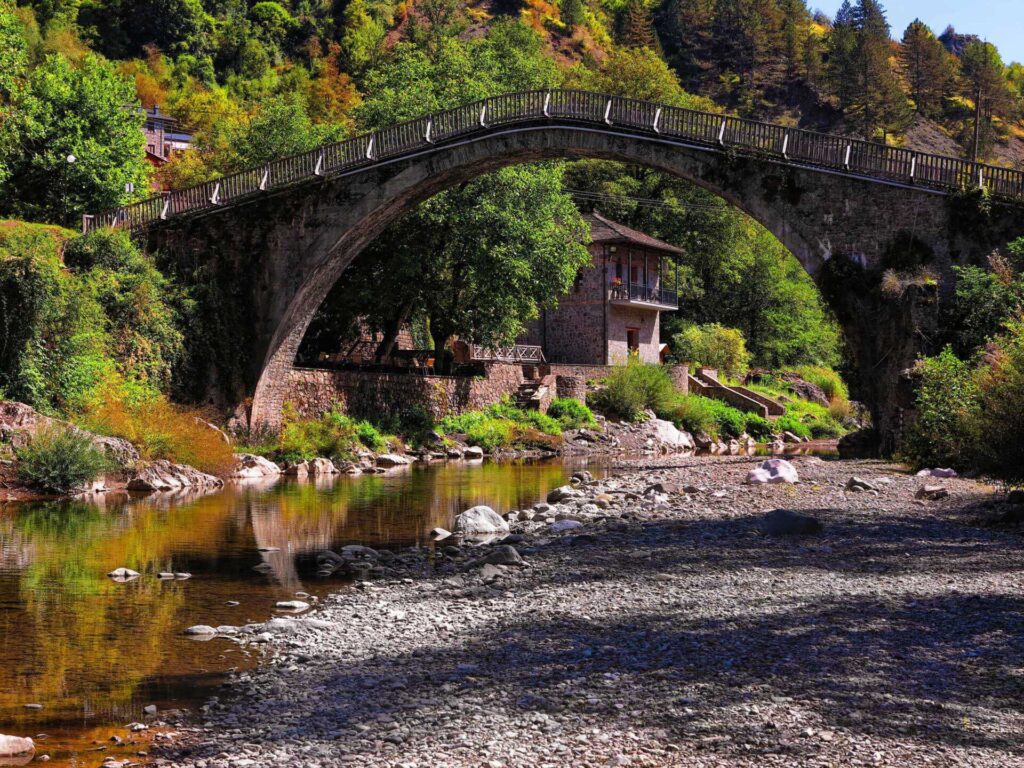
Small single-arched bridge at 995 m altitude, in the homonymous location in the south shortly before entering the village above Asprorema (Aroulou Albu in Vlachs), which flows into Aoos river. The villagers call it “La Puntika”, a Vlach name meaning “small bridge”. It is unknown when it was built and who built it.

The water power museum
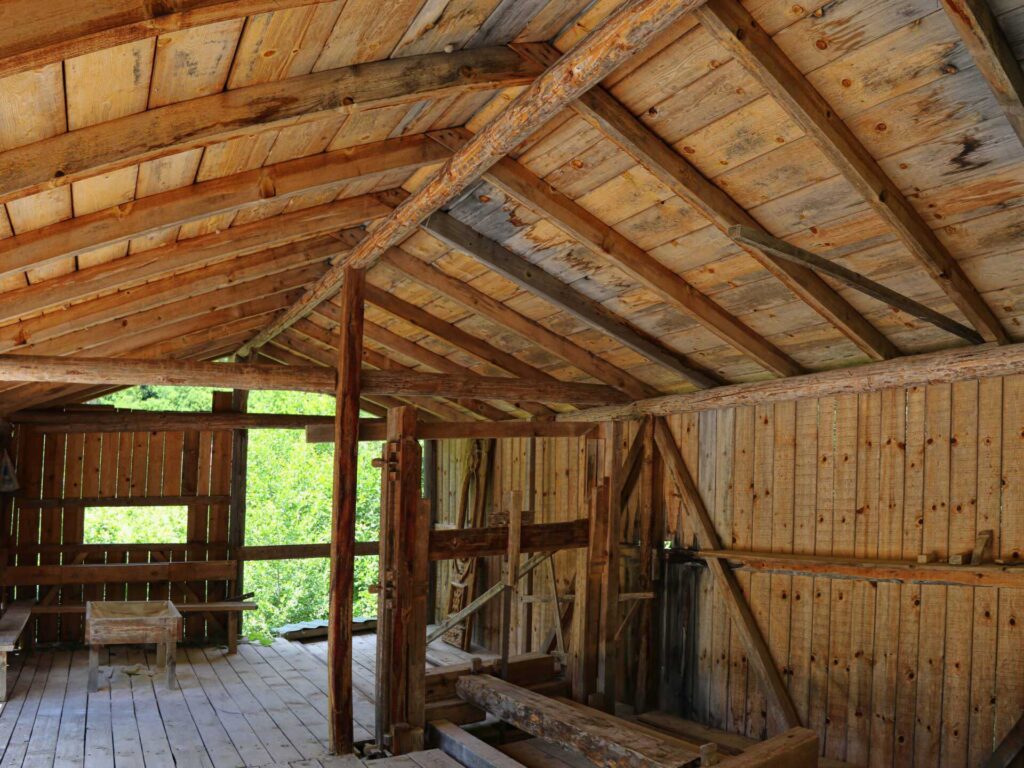
It is worth the visit because after many years, the historic water saw was put into operation with the assistance of the experienced craftsman Alekos Drougias. The magnificent construction that the lumberjacks of the area dismantled and rebuilt depending on the place where they worked to cut the logs, is an achievement of the versatile craftsmanship that combines technology with the power of nature. With minor repairs and the power of the Aoos, the engine started again on the first day of August 2020.
Churches
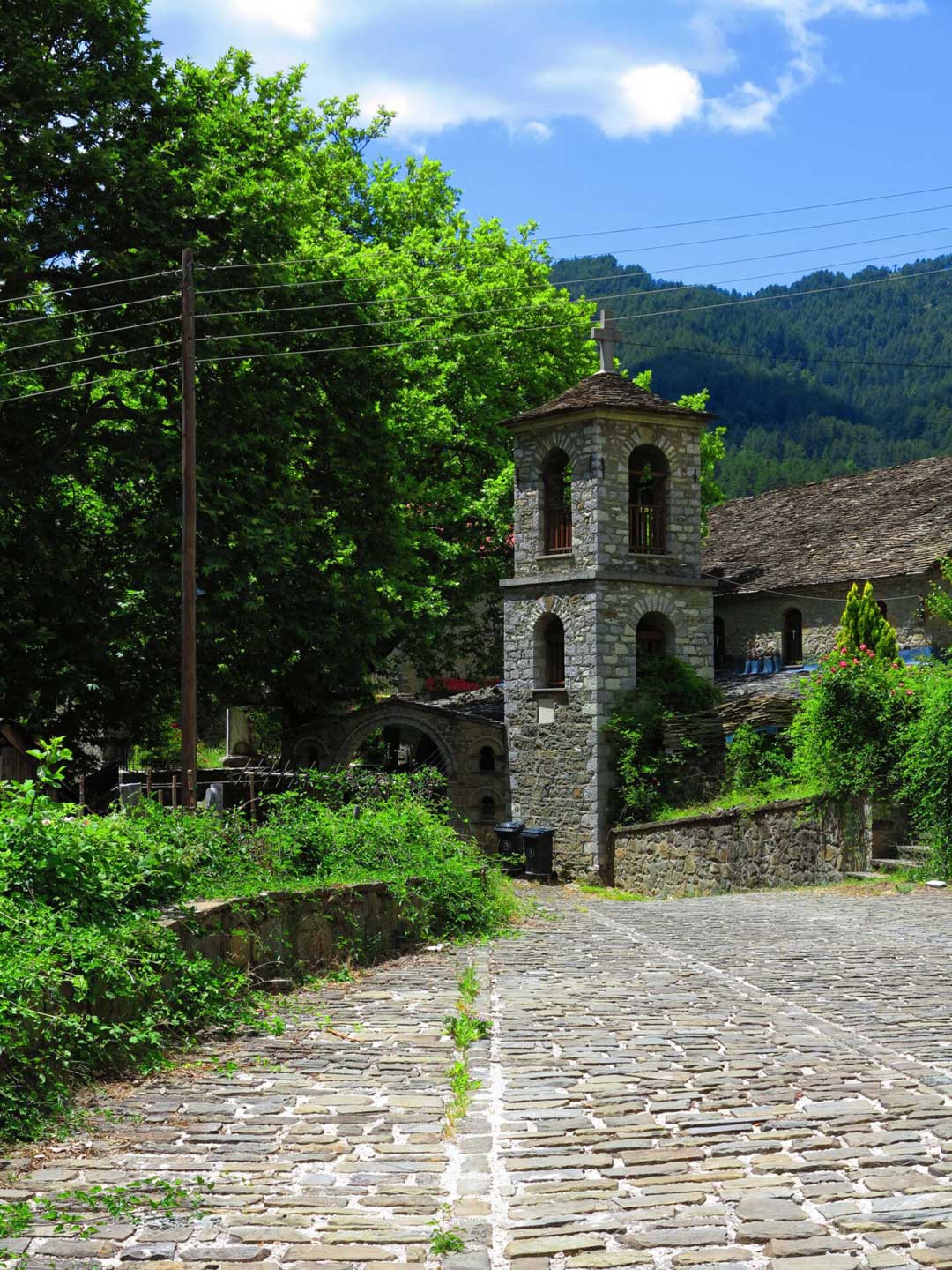
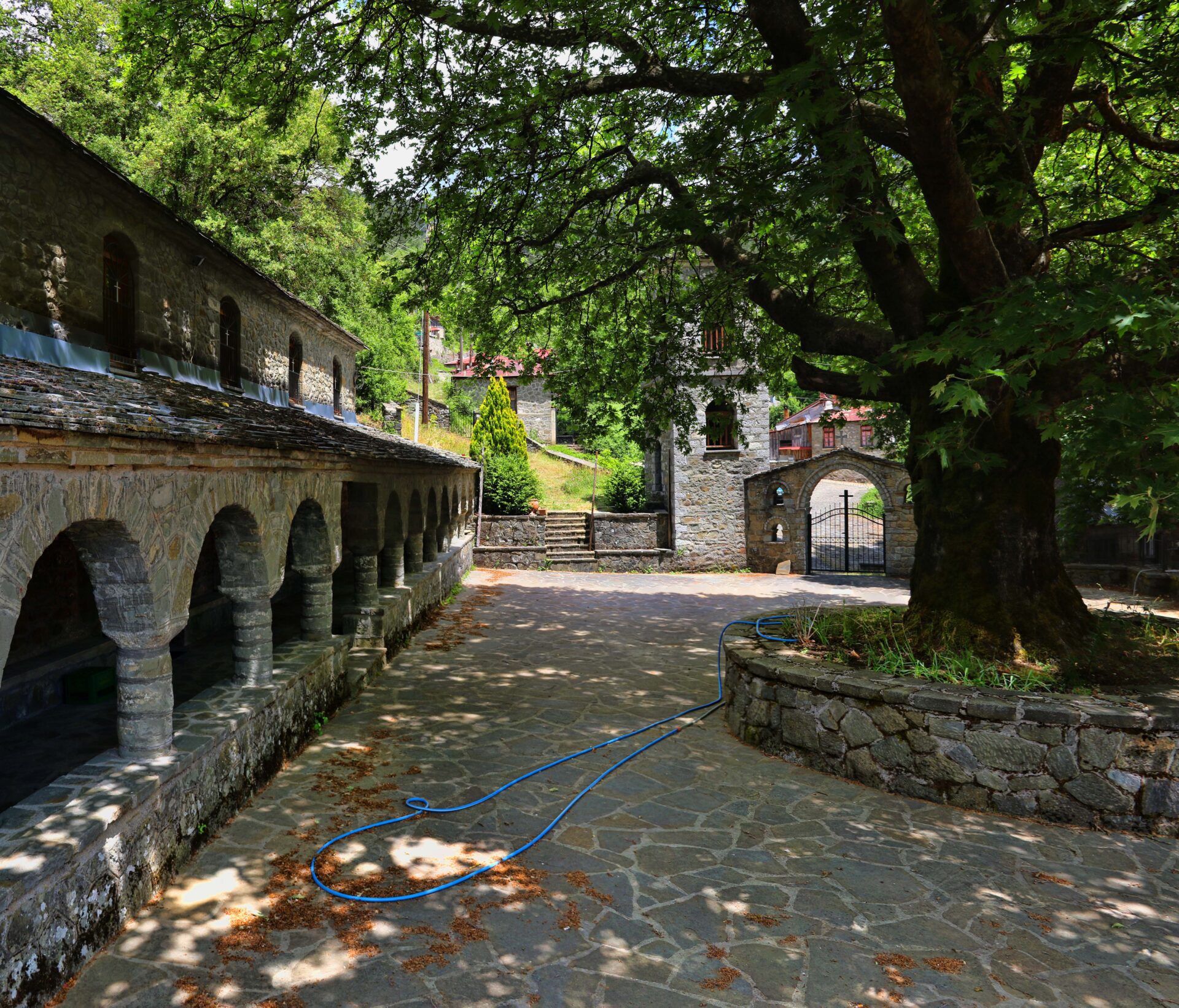
The churches of Agios Georgios (building of 1814), Agia Paraskevi (where the divine service takes place every July 26 and the traditional three-day festival of Vovousa) and Panagia stand out, as well as the Primary school built at the expense of Petros Kazanas.

The forest of Agia Paraskevi in Vovousa
In Epirus, in the mountains of Zagori and Konitsa, there are many natural places dedicated to churches, chapels, icons, where old trees and age-old forests are found. Along with the effort to systematically record them and highlight their importance as valuable elements of our natural and cultural heritage, the idea was born to study whether these sites are of particular value for the conservation of nature and biodiversity.
This idea finally took shape with the project Project: THALIS-SAGE (Sacred Groves of Epirus), which was coordinated by the University of Ioannina and in which scientists of many different specialties, both natural and humanities, from five different countries participated. The five-year cooperation and research provided many interesting facts, most importantly that the sacred forests of Epirus functioned as sanctuaries for the conservation of biodiversity, long before words like “sustainability” or “nature protection” are heard that have now become part of our daily vocabulary.
The example of these places, both in the research area in Epirus and elsewhere, shows how the local communities of the past managed to preserve Nature. Because these small communities have been able to preserve these forests for their own values and by serving their own goals, they are now gaining in importance.
In 2015, the sacred forests of Zagori and Konitsa, which are home to dozens or even hundreds of centuries-old trees, were included in the national list of intangible cultural heritage of UNESCO. According to the UNESCO definition, intangible cultural heritage refers to collective representations, practices, expressions, values, knowledge and skills associated with specific communities, groups or individuals and passed down from generation to generation.
One of these forests is the forest of Agia Paraskevi in Vovousa which is dedicated to the church of Agia Paraskevi. It is located at the top of the homonymous hill and celebrates on July 26. There are some of the largest black pines of Pindos and many trees that die naturally from old age. It is one of the most well-preserved forests in the area. The forest is about half an hour away from the village and is approached following a path that starts from the stone bridge of Vovousa.
Source: The information has been translated from: Τα Μεγαλειώδη Δέντρα του Ζαγορίου και της Κόνιτσας, Πανεπιστήμιο Ιωαννίνων 2015, Έργο: ΘΑΛΗΣ – SAGE «Η διατήρηση της Φύσης μέσω της Θρησκείας – Τα Ιερά Δάση της Ηπείρου»
The valley of Valia Calda
Vovousa is located in the center of the National Park of North Pindos, next to the famous Valia Calda and in areas of exceptional beauty. Since the founding of the Pindos National Park in 1966, it includes the valley of Valia Calda and Arkoudorema as well as the mountains Lygkos and Mavrovouni. Its area reaches 70,000 acres of which 33,000 are the core. In 2005 the Forest merged with the nearby Vikos-Aoos National Park, forming the North Pindos National Park, which is now the largest Park in our country.


The name “Valia Calda” means in Vlach “Warm Valley” although this is a euphemism since it is one of the coldest and wettest areas in the country. The predominant element of water in the area, the wild forests, the snow-capped peaks, the rapid streams and the beautiful glades compose an amazing scenery of natural beauty with unique ecological interest on a national and pan-European scale.
The richness of biodiversity and the important presence of protected species such as the Brown Bear and the White-tailed Vulture is truly impressive. It is one of the 2-3 most important virgin and wild places of our country.


Activities
Exploring nature is a unique experience and the options are many depending on the time available and preferences: routes, others on asphalt roads to neighboring areas and villages, others on passable dirt roads, and others purely hiking trails. Circular hiking routes starting from the bridge of Vovousa, amazing route with 4×4 from Vovousa to Gyftokampos.
The Mountain shelter “Valia Calda”
In a wonderful mountain setting, in 2001 was built the shelter “Valia Calda” of Vovousa which can accommodate 50 people and on the ground floor the restaurant can serve up to 100 people. The outdoor shelter during the summer months is an oasis. Part of the outdoor area of the shelter is used for camping.
For mountaineering and other activities in the area, the people in charge of the shelter are the most suitable people for any information. http://katafigiovaliacalda.com
Vovousa Festival
From 2015 and from July 16 to August 7, the Vovousa Festival is successfully organized every year. Music events, theatrical performances as well as modern dancing, hiking trips, truffle hunting, herbal medicine, intangible cultural heritage and oral history are organized.
«Protect Aoos» MTB Ultra
The Protect Aoos MTB Ultra for the protection of the Aoos is the most demanding mountain bike race in Greece and every year it attracts dozens of athletes from all over the country.

Festivals and Events
In the early 1900s, when men worked in the “water saws” as lumberjacks in the forest, returning home every 15 days led to a party, sometimes with local companies or others that were not local.
The local festival is organized every year on the day of celebration of Saint Paraskevi on July 26th. After the service in the church of Agia Paraskevi, they gather in the village, where visits with the accompaniment of musicians and an all-night feast follow. The festival ends with a feast the next night.
Another festival takes place on August 15th on the celebration of the Virgin Mary where the dance is accompanied by songs without an orchestra.
June 23-24 of Ai-Giannis or Giliata (Bride bazaar): Until the end of the 1960s, this event gave the opportunity to dance as first dancers to women who did not have a husband at home, and it was not possible at other events to dance in front if they did not have a male escort. Of course, the “Bride bazaar” also operated through the dance, where women alone were invited to dance in the middle of the village. This enabled men to “look” and “choose”. Today the dance takes place in the various shops. The dance is always accompanied by an orchestra and the songs are the same as those heard at other events.
At Easter the General Dance takes place in the courtyard of the church of Agios Georgios after the Second Resurrection on Sunday afternoon and at Carnival the songs heard were mocking.
Matchmakings, engagements and weddings took place in the houses and relatives were present. All the customs regarding the ritual were observed and a feast followed with songs from the mouth or with an orchestra.
The music and dance tradition of Vovousa is culturally different from the other Vlach communities of East Zagori (Greveniti, Flampourari, Elatochori), which have assimilated more elements of the Zagorian music tradition.
The music and dance repertoire of Vovousa has influences from the neighboring areas of Grevena, Metsovo and the Vlach villages of western Pindos, but shaped in a special style different from the other neighboring cultural units. After World War II, the demographic problem due to internal migration in the urban centers of the country altered the social fabric of the community.
Many of the social events no longer take place and only the three festivals are revived today but not with the dynamics of the past: the Little festival on June 23, the three-day festival of Agia Paraskevi on July 26 and the festival on the 15th of August. Weddings and name days are becoming more and rarer. However, today the people of Vovousa believe in the singing and dancing continuity that has preserved many of the elements of the past, which they try to highlight as faithfully as possible in the authentic and traditional form of the ritual part of the festivals.