






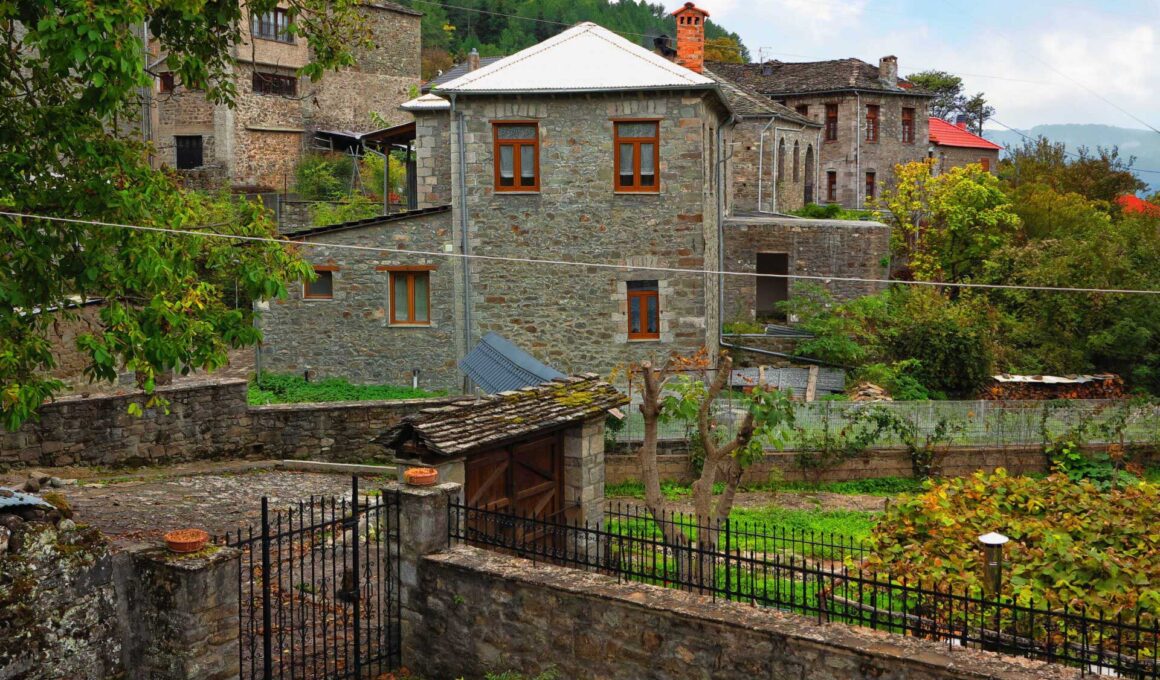
Molista
If you were my homeland,
my own town,
you would read in my eyes,
and the fountain would not murmur
so sad,
Molista, Molista
Corner inhabited with the Slavic name
Extremes of my loneliness.
And yet
the stranger loved you
that morning.
Renos Apostolidis, Poetic letters 1949
About Molista
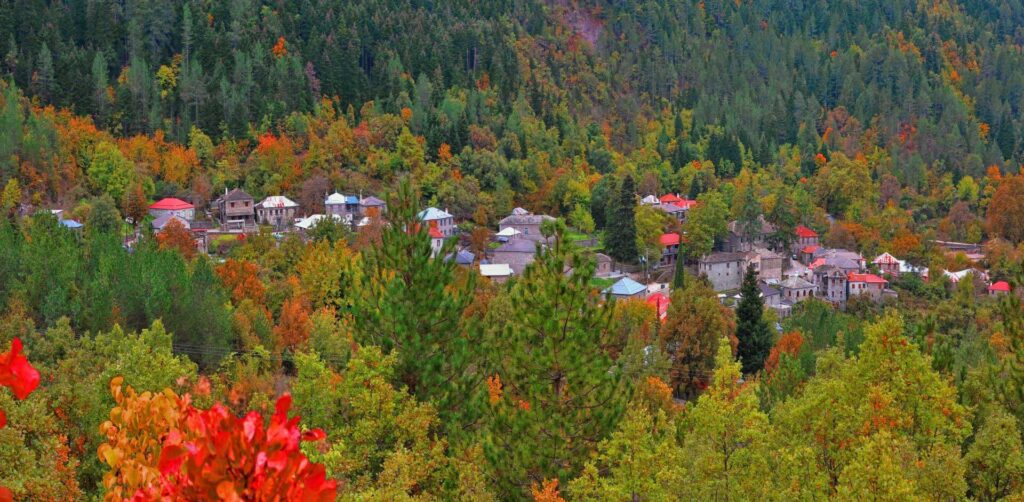
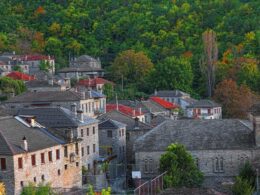
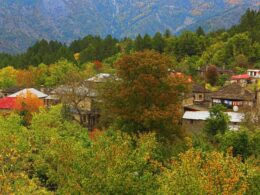
It belongs to the historical and cultural unit of Mastorochoria of Konitsa. Together with the two neighboring villages of Ganadio and Monastiri, they are also known as “stone villages” and are characterized as traditional settlements.
From long ago, these three villages had the common name Molista because they constituted a single community with three settlements (mahalades). In 1919, with special decrees, it was recognized that the community of Molista included these three settlements, as well as the monastery of Theotokos. Later it was defined that the settlements of Gannadio and Botsifari (which was renamed in 1928 to Monastiri) constitute independent communities (from 1920 and 1934 respectively) with the result that Mesaria officially acquired the name Molista.
From Molista as well as from the other villages known as “Mastorochoria of Konitsa” comes a large part of the craftsmen of Epirus. Builders who, using every material according to the local conditions, managed to build houses based on the Byzantine architectural tradition, to build bridges with stone arches, to carve works of art on stone, to give breath to the wood and to decorate not only the mainland but to promote their art beyond and outside Greece.

Historical data
In the valley that is formed at the foot of Gyftissa, peak of Smolikas, from long ago there were scattered houses that formed the settlement of Sioupostiani. (According to local tradition, “gypsy” is called a peak east of the village, where a barefoot gypsy woman with black hair and copperplates came out and played the tambourine when the Turkish Kotzambasis came to collect from the villagers the local taxes).
From ancient times until the 19th century, one of the main communication routes of Epirus and Macedonia passed through there. In the location of the valley from the very old years there were scattered houses that formed the settlement of Sioupostiani. According to sources, before its desolation, the settlement was composed of 40 families, a church and a cemetery.
The first mention of the toponym of Molista is in the code of the monastery Zavorda in Grevena, where the names of residents from Molista who offered financial assistance to the monastery dating back to 1534-1692 are recorded.
The historian Ioannis Lampridis in “Zagoriaka” (p. 87) states that after the dissolution of Skamneli in Zagori and the settlements around it, from the raids,a part of the inhabitants took refuge in Moschopolis (Lamprides mentions it as Voskopolis, its original name, probably due to the livestock activities of its older inhabitants), others in Sopiki and others “in Molistα“.
The Slavs who settled there in periods between the 6th and 14th centuries, as farmers, after their military raids, over time became Hellenized.
According to tradition, the settlement of Sioupostiani was deserted either due to an epidemic of plague, or due to frequent robber attacks, because it was located near the main road of Kapiliou-Fourka-Macedonia. Most of the residents emigrated abroad, some moved near Constantinople, while the rest settled in the other settlements of today’s Molista.
After the desolation of Supostiani (1670) the settlements of Molista formed a single community until 1864
Source: The text is translated from information we found in: Η επαρχία της Κόνιτσας και η Μόλιστα επί τουρκοκρατίας (Χαρίλαος Γκούτος, καθηγητής Παντείου Πανεπιστημίου, Παράγραφος 13 – Η Σουπόστιανη και οι απαρχές της Μόλιστα, σελ.79)
The battle of Molista and its liberation from the Ottomans
The inclusion of Konitsa in Greece on February 24, 1913 was a result of the liberation struggle that began in 1908 with the emergence of rebel groups against the Ottomans and the appearance of military bodies in the wider area of Konitsa. From the winter of 1912, revolutionary actions took place in the villages of the Lakka of Aoos.
On February 9, 1913, Captain D. Papanikolaou liberated the village from the Turks and established two companies in the village. The Ottomans, led by Dziavit Pasha and with many forces, attacked in a last attempt to retake it, but were repulsed with several losses. When the Ottomans learned about the liberation of Ioannina (21/2/1913), they left not only the village but also Konitsa.
Source: The text is translated from information we found here: Η απελευθέρωση της Κόνιτσας – Νικ. Αναστασόπουλος
Names and Renames
Mesaria, now known as Molista, is a picturesque settlement nestled snugly between Ganadio and what is today Monastiri. Its evolution as a settlement likely began concurrently with its neighbors. The name ‘Mesaria’ is a common toponym in Greece, typically signifying a central location or a settlement that lies in the heart of an area.
Delving into linguistic roots, the Old Slavic word “molista” translates to “supplicant”. This hints at a fascinating slice of history, suggesting that the area may have once been home to a monastery or church housing a revered icon of the Virgin Mary, known as Panagia Molista. This name likely originated from the Slavic settlers who, following their incursions into the region, held the icon in high esteem. The name ‘Molista’ then became synonymous with the monastery or church that enshrined this sacred icon, a site of pilgrimage that retained its significance even after the Slavic icon bearers either departed or assimilated with the Greek populace. Thus, the term “monastery or church of Molista” became a cultural and historical landmark in the region.
Contrastingly, the theory that the name ‘Molista’ might derive from ancient Molossia is less convincing.
Source: The text is translated from information we found here: Η επαρχία της Κόνιτσας και η Μόλιστα επί τουρκοκρατίας (Χαρίλαος Γκούτος, καθηγητής Παντείου Πανεπιστημίου, παράγραφος 12, Ετυμολογία των ονομάτων των οικισμών, σελ. 73 και 77)

Administrative Organization, Justice and Taxes
Post the Turkish conquest around 1417, the Molista region was woven into the administrative tapestry of the Ottoman Empire. Initially falling under the jurisdiction of the kaza (province) of Konitsa within the santzaki (region) of Korçë, it later transitioned to the santzaki of Ioannina after 1500. The governance of Molista during this era was a tapestry of various roles and responsibilities, involving figures like the governor, the priest (katis), village provosts, the council of provosts, the timariou (spachis) of the region, and state tax collectors.
Historian Pan. Aravantino paints a picture of these dignitaries – a mix of Mohammedans and Christian provosts – as a semi-independent and often unruly group. They maintained a mutual support system until 1790, when Ali Pasha’s strategic machinations brought about their subjugation by instigating internal conflicts.
The residents of Molista, alongside their neighbors, were frequently tormented by raids. These raids were mostly led by Albanian bandits and former charioteers turned thieves. Additionally, the oppressive feudal system placed a heavy burden on the villagers, enriching the local beys and agades through obligatory annual rents. However, Molista narrowly escaped becoming a feud (tsifliki), sparing its inhabitants from a perpetual rent obligation.
These recurrent invasions prompted the villages of Konitsa to devise a unique form of governance and self-rule, sanctioned by the Ottoman authorities. This system was led by the eldormen representing five villages in the province of Konitsa. These eldormen collectively voiced the opinions of the entire province and had the authority to resolve disputes.
The Vourkopotamos valley, today part of Ganadio, was a strategic derveni (pass) from the 17th century until 1790. The derveni’s guards, under the leadership of a chief, were tasked with collecting tolls from travelers and a protection tax from locals. Notably, between 1722 and 1743, the Molistines were entrusted with guarding this vital pass and had the right to collect tolls, highlighting their significant role in the region’s history and security.


Economy and Occupations
The tapestry of Molista’s history is woven with the stories of its earliest inhabitants – nomadic shepherds whose lives were intricately tied to the rhythm of the seasons. During the frosty winters, they would migrate to the plains of Thesprotia, and as summer warmed the earth, they ascended to the lush pastures of Smolikas and Grammos. Their pastoral existence was anchored by the “tseligato,” a simple yet efficient system of cooperative herding.
G. Lymperopoulos, in his book “Mountain and Border people,” details the unique construction of their dwellings, akin to the methods of the Sarakatsani people. Each shepherd family constructed two huts – a permanent one for the winter and another for their summer sojourns in the mountains. The winter abodes were circular, while the summer shelters were larger, rectangular structures, catering to the expanded needs of the warmer months. These huts, left to the mercy of the elements in winter, often succumbed to harsh weather, leading to an annual cycle of reconstruction and improvement.

The shepherds of Molista were in harmony with nature, drawing on its bounty for sustenance and shelter. The forests provided timber, forage for livestock, and a wealth of plants and herbs. Along the coast, small-scale farming flourished, yielding pulses, cereals, wheat, potatoes, and more. Historically, sericulture was also a prominent activity. Viticulture was another cornerstone of their economy, with each household reportedly producing around 700 okades of exquisite red wine and tsipouro, thanks to the region’s abundant vineyards and diverse grape varieties.
The village’s numerous water sources, including the Vourkopotamos and Sarantaporos rivers, not only nourished their vegetable crops but also supplied them with fish. Moreover, the local orchards were a testament to the region’s fertility, brimming with walnut, cherry, apple, and plum trees, painting a picture of a community deeply intertwined with the land they called home.
The craftsmen of Molista
It is unknown how old is the building tradition. The first report on construction activity and in fact with a large number of builders from Molista is documented by a list of 19 September 1801. In this list among the 789 builders and 1026 skilled workers are registered and 35 craftsmen from Molista. (unissued file of Ali Pasha).
Usually, in the beginning of spring, the craftsmen formed groups, the “bouloukia”, and left their village for pre-agreed work.The return of the “bouloukia”, took place in November. During the winter they were with their families until the following spring when they left again.
From Mesaria (Molista) known groups were those of Vassiliou Harisiadis and Athanasios Serifis.
The craftsmen from Molista extended their activity beyond the borders of Epirus. In their pre-war travels there were also cases where women from Molista followed and helped their husbands. This is a very interesting and rare case. Of course, it is a fact that the Molista women- like the Sarakatsani women – were famous for the fact that they themselves built the round wooden huts.
In 1938-1940 they worked with the craftsmen from Pyrsogianni and Kerasovo on road construction projects (openings, bridges, masonry) of the roads in the areas of Xanthi, Kavala, Rupel forts. They worked until the day when the War was declared in ΄40. After the war it is not known if the Molistines continued to practice the art.
Since then the shift of the inhabitants towards emigration to Romania and the change of profession resulted in the gradual decline of Molista as a center of craftsmen. With the outbreak of the Russo-Turkish war (1877-1878) in which Romanians also participated, they had the opportunity to get rich because the passage of Russian troops through Romania left a lot of money in grocery stores and bakeries. Both the Molistines indulged in these two professions, managing to get rich.
Source: The text is translated from information we found here: ΜΑΣΤΟΡΟΙ ΧΤΙΣΤΕΣ ΑΠΟ ΤΑ ΜΑΣΤΟΡΟΧΩΡΙΑ ΤΗΣ ΚΟΝΙΤΣΑΣ, ΑΡΓΥΡΗΣ ΠΕΤΡΟΝΩΤΗΣ ΒΑΣΙΛΗΣ ΠΑΠΑΓΕΩΡΓΙΟΥ – Η τρίκωμη Μόλιστα, σελ. 667
Architecture
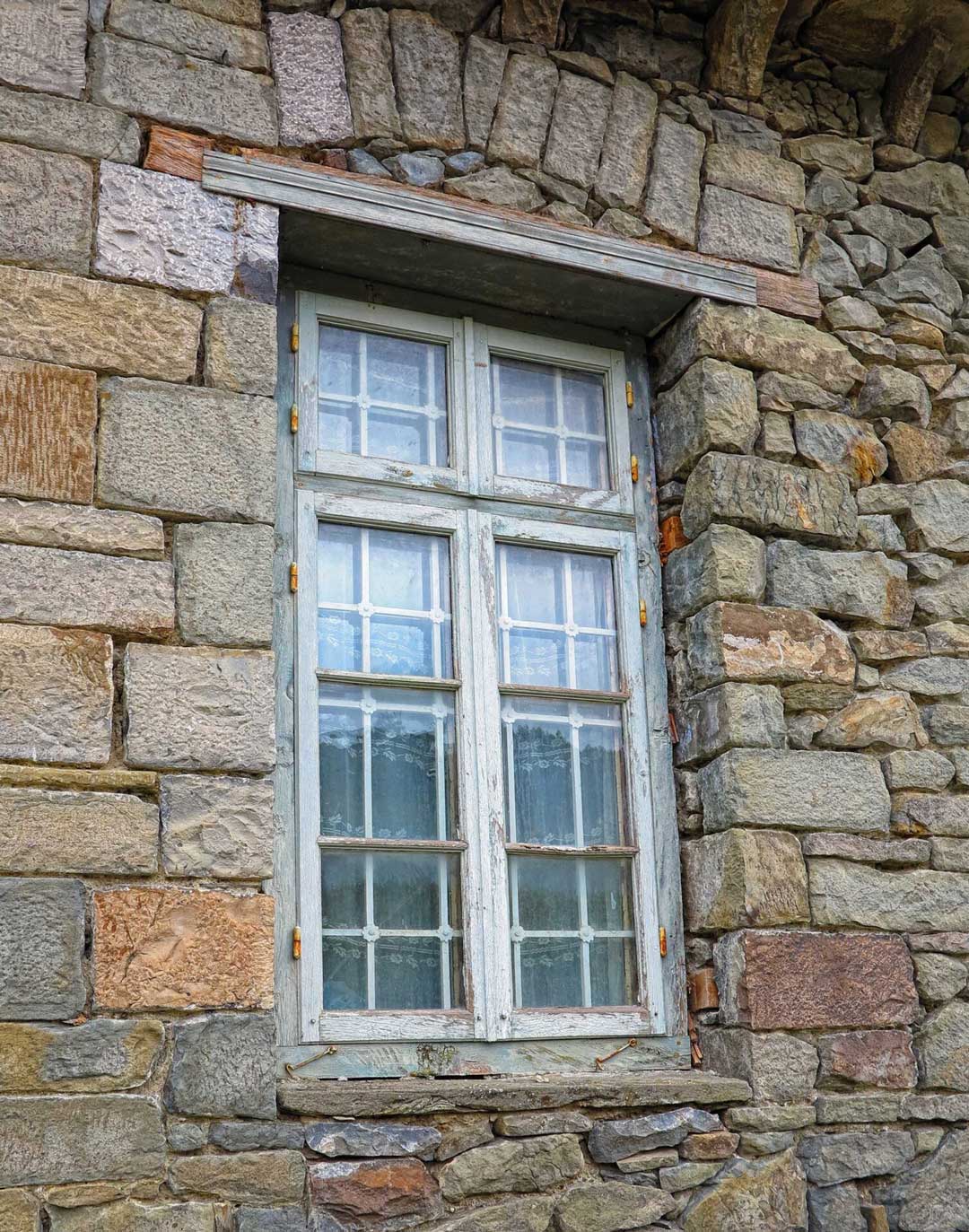
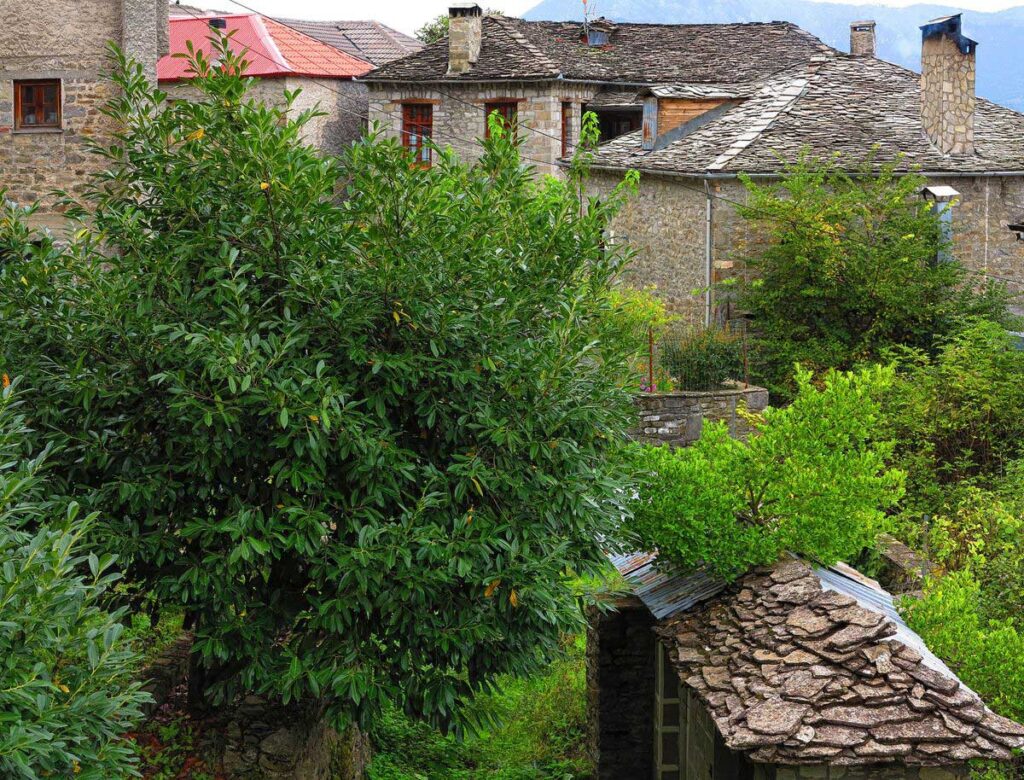
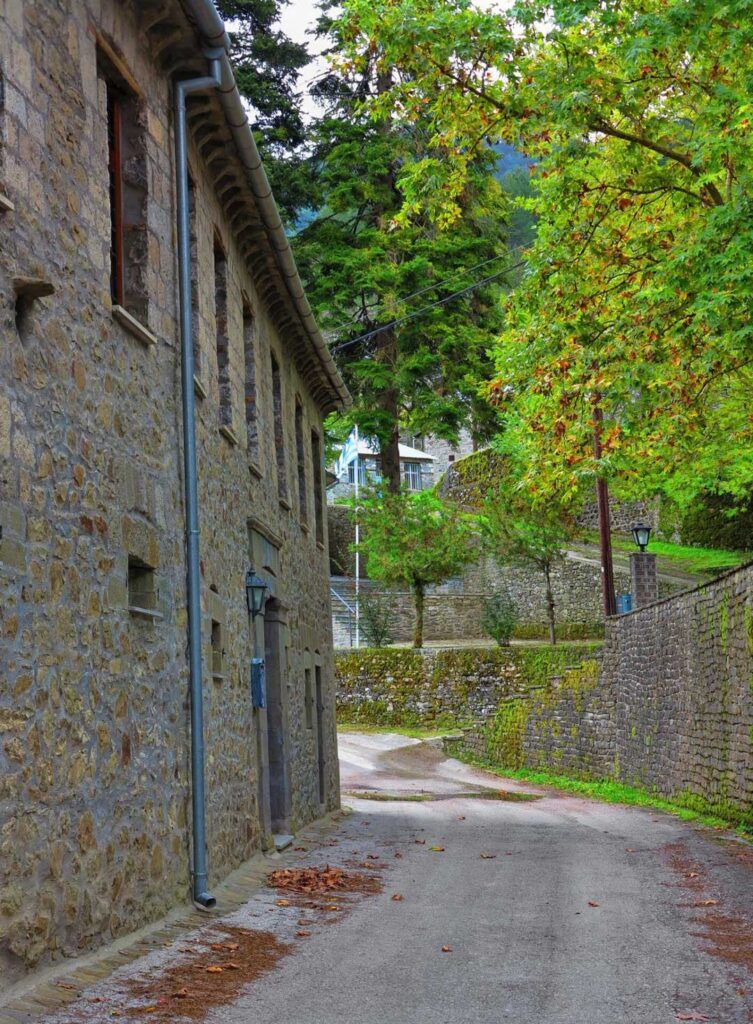
A characteristic element of the houses is the fortress character with thick walls, few openings, heavy wooden beams and dark stone from the mountain.
The only decorative element is the wooden ornaments of the windows or the simple stone decorations of the lintels. The yard, usually fenced with dry stone, is the main area of the house for all seasons. It is paved, with flowers and trees and has the necessary spaces around it.
The high stone fence gives the feeling of seclusion and freedom to the owners when they are in the yard. The simple construction also characterized the interior of the house with the small wooden centerpieces for storing clothes and the fireplace with the elongated sofas (mpasia) were the furniture. The only decorative element was the colored embroidered covers on the sofas.
Dark wood is the material for floors, lintels, stairs, balconies and wardrobes. Individual cases of sashnisia (protruding windows) indicate the tendency of craftsmen to process the simple stone face, enriching it with some additional aesthetic elements and give a picturesque look to the building. The building materials they have – are limited and when given the opportunity they work with stone art making fireplaces, balconies and stairs with wonderful construction perfection.

Education in Molista
The educational landscape in Molista during the 19th and early 20th centuries was nothing short of remarkable for its time. Historical documents dating from 1828 to 1913, bearing the signatures of teachers, priests, and ordinary residents from Canada, bear testament to the high levels of literacy among the inhabitants. Before the formal establishment of schools, tradition dictated that priests and occasional “letter teachers” undertook the noble task of imparting knowledge. In the mid-19th century, around 1850, Molista saw the influence of Georgios Tzounis from Staritsani, a collaborator of Kapodistrias, who played a pivotal role in education. Handwritten notes in the monastery books of Molista hint that various other educators contributed their expertise from time to time.
In 1846, Nikolaos Xinos, residing in Bucharest, bequeathed a portion of his property to Molista, with the explicit purpose of constructing a school for underprivileged children. The result was the Spyridonian School, which was built using these funds and provided free education. This institution became a beacon of learning, ensuring that many Molinists received an education even during the challenging period of Turkish occupation. After completing their studies at this school, children often continued their education at the High Schools of Tsotyli or Ioannina. However, in 1929, the Spyridonian School sadly closed its doors.
Another philanthropic gesture in 1848 saw Michael Nazis, who had also established himself in Bucharest, allocate his assets for the establishment of a girls’ school in the village. These endeavors in education, fueled by the generosity of individuals like Xinos and Nazis, left an indelible mark on Molista, fostering a culture of learning and empowerment that transcended the adversities of their time.
Source: The text is translated from information we found here: Η επαρχία της Κόνιτσας και η Μόλιστα επί τουρκοκρατίας (Χαρίλαος Γκούτος, καθηγητής Παντείου Πανεπιστημίου, Σχολική Μόρφωση σελ. 96

What to see
The bridge in Kouklioi
Also known as the bridge of Kryoneri and Vergos. It is located 25 km north of Konitsa to the right of the national road and below the village of Monastiri (former Botsifari) at the site Kouklious, next to the homonymous old inn (later Kotli and Vergos inn).
It bridges the Sliouta stream pit or Cortinistα stream that starts from Cortinista lage (today Nikanoras) and is poured into Sarandaporos river. It is a single arch with an opening of 8.30 m. and the height from the riverbed reaches 4.50 m and peaks in the center at 5.20 m. The curved corridor reaches 20 m in length and 2.40 in width with low and sparsely placed arkades (oblong stones).
The builder of the bridge was Fotis Lolos from Vranista (today Trapeza) according to the claims of his descendants but also from the peculiar technique of the specific carpenter who documents it as his own work. It was built in the second half or late (most likely) of the 19th century.
Source: The information is translated from text we found here: ΤΟ ΓΕΦΥΡΙ ΣΤΟΥΣ ΚΟΥΚΛΙΟΥΣ, ΣΠΥΡΟΣ Ι. ΜΑΝΤΑΣ, ΓΕΦΥΡΟΓΡΑΦΙΑ ΤΗΣ ΠΙΝΔΟΥ ΤΟΜΟΣ Γ΄-ΤΑ «ΗΠΕΙΡΩΤΙΚΑ» ΠΕΤΡΟΓΕΦΥΡΑ Σελ. 138

The bridge in Vourgopotamos (Kerasovitiko river)
In the past, the main road from Konitsa to Mastorohoria and Macedonia reached the left bank of the Bourgopotamos and at the point where it met Sarandaporos it branched off following the valleys of the two contracting rivers.
One of the two branches headed through the valley of Sarandaporos, towards Macedonia. The danger of crossing at that point of the river logically meant that there was a need for a bridge.
Around 1968, when the new large concrete bridge of the National Road was being built, a small piece of the spine of the old stone bridge was visible, but no one then gave any explanation. The bridge was then pushed back in.
Neither the old craftsmen, nor the agogiates never mentioned such a bridge. There was no mention of it by foreign travelers or local geographers, and neither was there any written mention or recollection from the accounts of older people.
During the winter of 2002/3, a large and rapid water descent of Vourgopotamos brought to light the top part of a stone arch, confirming the correctness of the thought, that there must have been a bridge there. This stone arch was captured in detail in the summer of 2003 by Professor Argyris Petronotis and presented in an article in 2004 in the Magazine “εκ Χιονιάδων”, issue 7, p.31.
An extensive text “The large, arched bridge of Vourgopotamos” of Molista written by Thomas B. Ziogas, civil engineer from Drosopigi, Konitsa published in the magazine “τα Καντσιώτικα” , issue 23, p.10, gives information about the bridge The bridge must have existed in 1878 because in written testimonies it is mentioned with the word “big” and this three-arched stone bridge in Bourgopotamos was indeed big, since it was 25.00 m long.
From the studies he made the design of the bridge was insufficient and the flow of the river and the transported materials which could not pass through the relatively small arches were not appreciated and it was left to its fate.
Sources:
The text is translated from information we found in the following sources:
«Η μεγάλη, τοξωτή γέφυρα Βουργοπόταμου της Μόλιστας», Θωμάς Β.Ζιώγας, πολιτικός μηχανικός, «τα Καντσιώτικα», τεύχος 23, σελ.10
“Το ξεχωμένο γεφύρι στην κοίτη του Βουρκοπόταμου Μόλιστας», Αργύρης Π.Π. Πετρονώτης , Περιοδικό «εκ Χιονιάδων», τεύχος 7, σελ.31.

Churches and Monasteries in Molista
St Nikolaos
Agios Nikolaos, the central church, a three-aisled basilica, with the iconostasis and wood-carved ceiling, and Agia Paraskevi, which is located in the Molista cemetery, outside the village and is dedicated to Agia Paraskevi because in the past the residents believed that this saint prevented plague epidemics having the tragic precedent of the epidemic that decimated the population and devastated Supostiani


The monastery of Presentation of Mary (The Monastery of Molista)
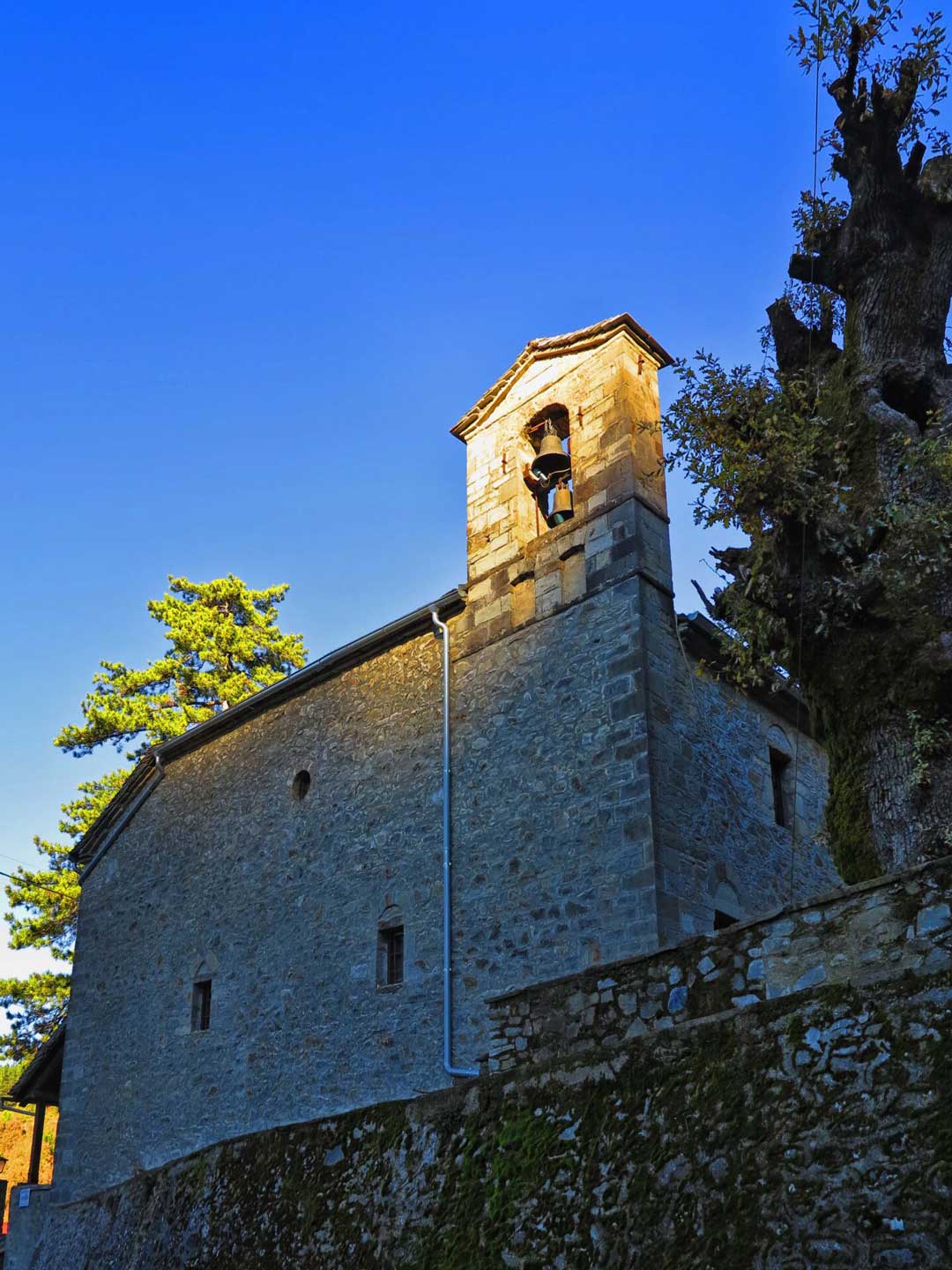
After the desolation of the original settlement of Supostiani, in 1672 a monastery was founded in Botsifari (today’s Monastery) to which the icon of Panagia Molista was transferred. It is speculated that the slippery terrain at that point contributed to the landslide, resulting in the abandonment of the original monastery by the monks and the foundation of the new one. According to the priest Georgios Paisios, from a study on a non-walled slab and other findings, the first monastery was built in 1672 and was preserved for about two centuries. Then it was destroyed and in 1819 it was built in its current location and completed in 1892. According to tradition, the Virgin Mary miraculously indicated the location where the monastery was built. In emergencies (drought, diseases) a procession took place in the village of the miraculous icon of the Virgin Mary.
Until 1940 the monastery was in prosperity and helped poor families of Molista, financially supported unmarried girls and pioneered public works. In the early 20th century it began to decline.
In January 1976, robbers broke into the door and stole the icon of the Virgin Mary, the so-called “Sratiotissa”, along with other relics.
Today, we can see the katholikon, the double bell tower at the entrance, the old stables, the two-storey cells, where monks lived until 1975 and which today serve as hostels for pilgrims, as well as a smaller building called “the Turk’s ledge” and is a benefaction of a Muslim bey.
The katholikon is a single-aisled basilica, with two doors and a gynaikonitis (the introverted women’s wing in the Greek churches). In the main church are preserved two stone manuals of 1831, a wooden iconostasis and rare icons.
The Monastery celebrates on November 21, with a solemn service.
Sources: The text is translated from information we found in the following source: Μοναστήρια της Επαρχίας Κονίτσης – Πρεσβ. Διονυσίου Δημ. Τάτση


The post of Molista
In the past, agogiates (those who transport products with animal ) were used as postmen for postal communication in Molista. A post office started operating in Konitsa around 1877 and in 1881 a telegraph office was established.
The mayors of the three communities of Molista (Supostiani, Messaria, Botsifari) and Pournia ,in 1960, in a letter reported to the Prefecture the existence of the Post of Molista which operated from 1913 for 47 years, served not only the inhabitants of the above villages but also those of Agia Paraskevi and Fourka and until 1958 the inhabitants of Drosopigi, Lagada and Kastaniani.
Two important events that took place that year played an important role in the establishment of the Molista Post Office. The first was the victory of the Greek army against the Turks on February 15 in the area of Molista when the Greek army recaptured Molista repelling the Turkish forces that withdrew with several losses. This victory made Molista famous throughout the Greek territory and in the then Greek Government. The second was the intense pressure exerted by the Molinist prominences of Bucharest, and of the three villages, on the then Greek Prime Minister Eleftherios Venizelos, who paid an official visit to Romania that year and had contacts with prominent expatriate Greeks.
The Post Office from its foundation in 1913 until 1983 was housed in a central building in the square. After the fire of the building it operated in another building until 1998 when it was permanently abolished.

Musical tradition, dances and festivals
The location of the wider area of Konitsa and its villages are located between Albania and Macedonia. Next was to accept musical influences from both areas and a rich music and dance tradition.
The main instrument is the clarinet, accompanied by the violin, the lute and the tambourine. Molista had and has some of the best musicians in the area of Konitsa who, with their companies and integrated into the local community, know the local customs and the preferences of the dancers.
At a time when the inhabitants of the villages lived in isolation, the only way to have fun was the festivals, weddings, big religious and name festivals, Halloween and carnivals. Festivals, religious and name festivals and various events were the only way of entertainment for the people of the villages. In addition, it was the best way for young people to communicate in an era of strict morals regarding the relations of the two sexes.
The simple and layered dances reflected the strict morals and customs of Epirus, where expressiveness was not allowed, especially for women.
At the dances the dancers danced in a single or double circle and were always accompanied by the instruments of the local instrumentalists. In the double-bar shape, the women danced inside and the men outside. Each man who led the dance, danced only with his wife, or with a very close relative. In the single circle the men danced in front and the women followed. When she danced, a married woman was held by her husband with a handkerchief, while the unmarried girls were held by one of their relatives, mother or sister. They usually danced against families.

Morals, customs and traditions
The social organization was characterized by strict morals and customs. Respect went beyond the meaning of the word. Women, no matter how old they were, had to greet the man even if he was young and if they were sitting they should stand up. Young men and women exchanged glances only at dances, weddings and festivals. The people of Molista were committed to traditions and deeply religious.
The distant past of living in nature, their strong bond with the earth and their love for animals was the reason for supernatural stories to be born about them. The dominant zoomorphic ancestors of the region were the snake, the bear and the goat. The serpent, born of the earth, was the reincarnation of the deceased. The bear protector of small children and the sick who are isolated in the mountains. The fertility symbol goat is associated with rain which is the first fertility element of the earth.
The zafetia were the feasts held for the return of a stranger, usually from Romania or Egypt, and in which only men participated, and they manifested the nostalgia of the stranger who tried in the short time of his stay in the village to have fun and keep, leaving, the good memories.
There are many customs and traditions associated with the travels of craftsmen. Their departure and return was always accompanied by songs of mourning at the time of farewell while the return was always a feast. Water-related traditions are also tied to the ritual of the craftsmen’s departure, and customs during the construction of houses (slaughter of roosters, tossing of coins).
Molista today
Today, the once-thriving village stands as a shadow of its former self, with only a handful of residents dotting its landscape. The vibrant festivities of old have been muted, a poignant reflection of the profound changes that have swept through this Greek countryside.
The scars of wars, waves of emigration, and a gradual departure from rural life have all contributed to the decline and desolation that now envelops Molista. The cherished “Zafetia,” once exuberant celebrations, have become subdued affairs. Name days are marked without the accompaniment of traditional instruments, and the festivities have lost their originality, their connection to the rhythms of everyday life severed.
Yet, amid the quietude, a glimmer of tradition endures. In the summer months, the village square comes alive with a festival that clings to its roots. This gathering, though smaller in scale, preserves the timeless ways of Molista and provides a precious opportunity for the remaining residents to come together in a place that will forever hold a special place in their hearts. As they gather, they cherish the echoes of a bygone era, finding solace in the enduring spirit of their beloved village.





2 comments